


- TabH2O is a foundation model for tabular data that performs in context learning, reading labeled data and making predictions in a single step without feature engineering, gradient updates, or tuning.
- TabH2O v1 outperformed tuned CatBoost and LightGBM across all 300 classification and regression tasks in the TALENT benchmark with zero hyperparameter tuning.
- TabH2O processes tabular datasets through three specialized transformer stages that handle features, rows, and the entire dataset, and was pretrained on millions of synthetic datasets with diverse causal structures.
- TabH2O returns predictions for most real world datasets in under three seconds, compared with tuned CatBoost taking nearly 10 minutes end to end on a typical TALENT task.
- TabH2O is available as a hosted API with a free tier, and users can sign up at tabh2o.h2oai.com with a LinkedIn or Google account to get an API key.
An advanced foundation model for tabular data — outperforming classical ML approaches, delivering accurate predictions in seconds with no training, tuning, or feature engineering required.
A Foundation Model for Tabular Data
Tabular data powers some of the most critical decisions in business — credit scoring, demand forecasting, clinical trials, fraud detection. Yet building a good model for a new dataset still requires significant effort: feature engineering, model selection, hyperparameter tuning, and weeks of iteration.
Foundation models transformed NLP and computer vision by training a single model that generalizes across tasks. TabH2O brings that same paradigm to tabular data. Pretrained on millions of synthetic datasets with diverse statistical structures, TabH2O performs in-context learning — it reads your labeled data, learns the patterns, and makes predictions, all in a single step. No feature engineering. No gradient updates. No tuning. Just data in, predictions out.
Architecture: Three-Stage Transformer
TabH2O processes tabular datasets through three specialized transformer stages. Each stage handles a different granularity of the data — from individual features, to rows, to the entire dataset — enabling the model to learn complex patterns across any schema.
What Makes This Architecture Special
Unlike traditional ML models that train on a single dataset, TabH2O was pretrained on millions of synthetically generated tabular datasets spanning diverse causal structures — from simple linear relationships to complex nonlinear interactions, multi-dimensional dependencies, and irrelevant noise dimensions.
Benchmark Results
We evaluated TabH2O v1 on TALENT, a comprehensive tabular benchmark spanning 300 classification and regression tasks curated by independent researchers. We chose TALENT over alternatives like TabArena for three reasons: scale (300 tasks vs. 51 gives far more statistical power), independence (TabArena is co-maintained by the AutoGluon team), and robustness (no single difficult dataset can swing the leaderboard). Models are ranked per task; lower average rank is better.
Average Rank
Key takeaway: TabH2O v1 outperforms every traditional ML approach — tuned CatBoost, LightGBM — across all 300 TALENT tasks, with zero hyperparameter tuning. Where GBDTs need per-dataset tuning and AutoML systems require significant compute budgets, TabH2O delivers superior predictions out of the box.
Predictions in Seconds
Traditional ML has a hidden tax: before you get a single prediction, you pay for training, cross-validation, and hyperparameter search. On a typical TALENT task, tuned CatBoost takes nearly 10 minutes end-to-end. TabH2O has no training step. Send your data, get predictions back — the entire operation is a single forward pass through a pretrained transformer.
For the vast majority of real-world datasets — think customer churn, fraud signals, sales forecasting — you'll have results in under three seconds. Larger datasets take longer, but even 50,000-row jobs finish in about 20 seconds.
How It Works: From Data to Predictions
TabH2O is designed to be as simple as a single API call. Under the hood, the model performs sophisticated in-context learning — but the complexity is completely abstracted away. Send your labeled and unlabeled data, get predictions back.
Auto-preprocessing handles the messy parts of real-world data: categorical encoding, missing value imputation, outlier detection, and feature normalization. In-context learning (ICL) is what makes the rest possible. Rather than fitting model weights to your dataset, TabH2O reads your labeled training rows directly as input — they become the context for the transformer. The model attends to those examples and predicts on held-out test rows in a single forward pass. No gradient updates, no training loop, no overfitting risk from small samples.
The TabH2O API
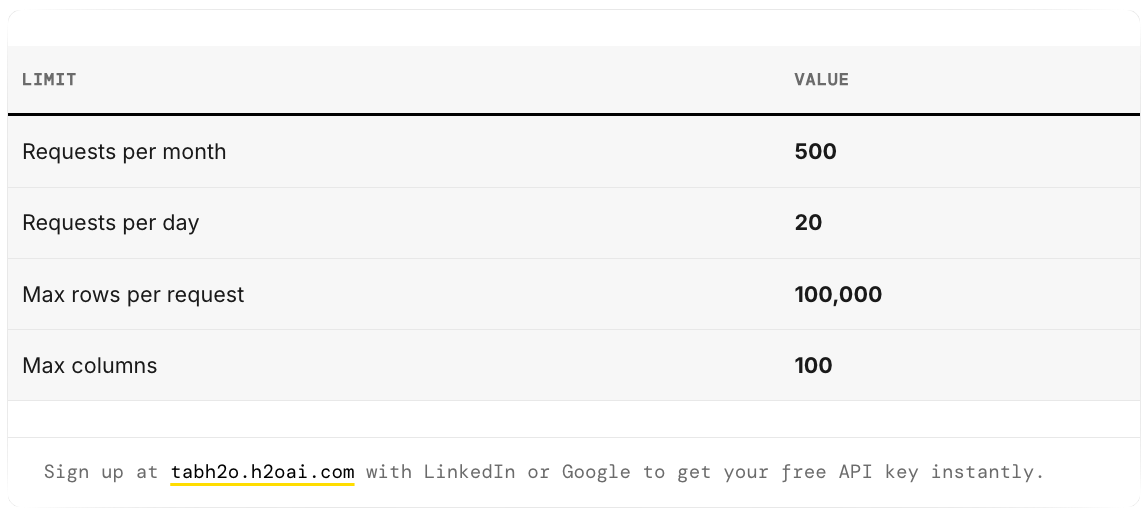
TabH2O is available as a hosted API with a generous free tier. Get started in minutes — no GPU, no dependencies, no setup. Just a single HTTP request.
A Single curl Request Or a Few Lines of Python
Bash/Shell
curl -X POST https://tabh2o.h2oai.com/api/v1/predict \
        -H "Authorization: Bearer YOUR_API_KEY" \
        -F file=@data.csv \
        -F target_column=purchased \
        -F task=classification
Python
import requests

API_KEY = "YOUR_API_KEY"

# Upload a CSV where rows with empty target get predicted

response = requests.post(
    "https://tabh2o.h2oai.com/api/v1/predict",
    headers={"Authorization": f"Bearer {API_KEY}"},
    files={"file": ("data.csv", open("data.csv", "rb"))},
    data={
        "target_column": "purchased",
        "task": "classification",
    },
)

print(response.json())
Free API Access
TabH2O is free to use. Sign up, get an API key, and start making predictions. Need higher limits for production? Contact us.
When to Use TabH2O
Getting Started
1. Sign up at tabh2o.h2oai.com using your LinkedIn or Google account.
2. Get your API key from the dashboard — it's instant and free.
3. Make your first prediction — a single curl request is all it takes:
curl -X POST https://tabh2o.h2oai.com/api/v1/predict \
    -H "Authorization: Bearer YOUR_API_KEY" \
    -F file=@data.csv \
    -F target_column=purchased \
    -F task=classification
The response includes predictions, class probabilities, and metadata. Only task-relevant fields are returned:
{
    "predictions": ["Yes", "No"],
    "probabilities": [[0.82, 0.18], [0.35, 0.65]],
    "metadata": { "task": "classification",
    "train_rows": 4,
    "test_rows": 2,
    "time_ms": 1234 }
}
Regression and time series return confidence intervals instead of probabilities.
Ready to try it? Head to tabh2o.h2oai.com to get your free API key and start making predictions in minutes. For enterprise deployments, dedicated GPU instances, or on-premise installations, contact our sales team.